- Published on
World Action Models: The Next Frontier in Embodied AI
- Authors

- Name
- Vishal V
- @VishalVignesh_
Notes
2.1 Foundational Paradigms
Vision-Language-Action (VLA) models are a class of embodied foundation models that frame robot control as a multimodal sequence modeling task (3)
VLA architecture typically leverages the pre-trained semantic latent spaces of Large Language Models (LLMs) or Vision-Language Models (VLMs) to map perceptual inputs directly to the action space (3)
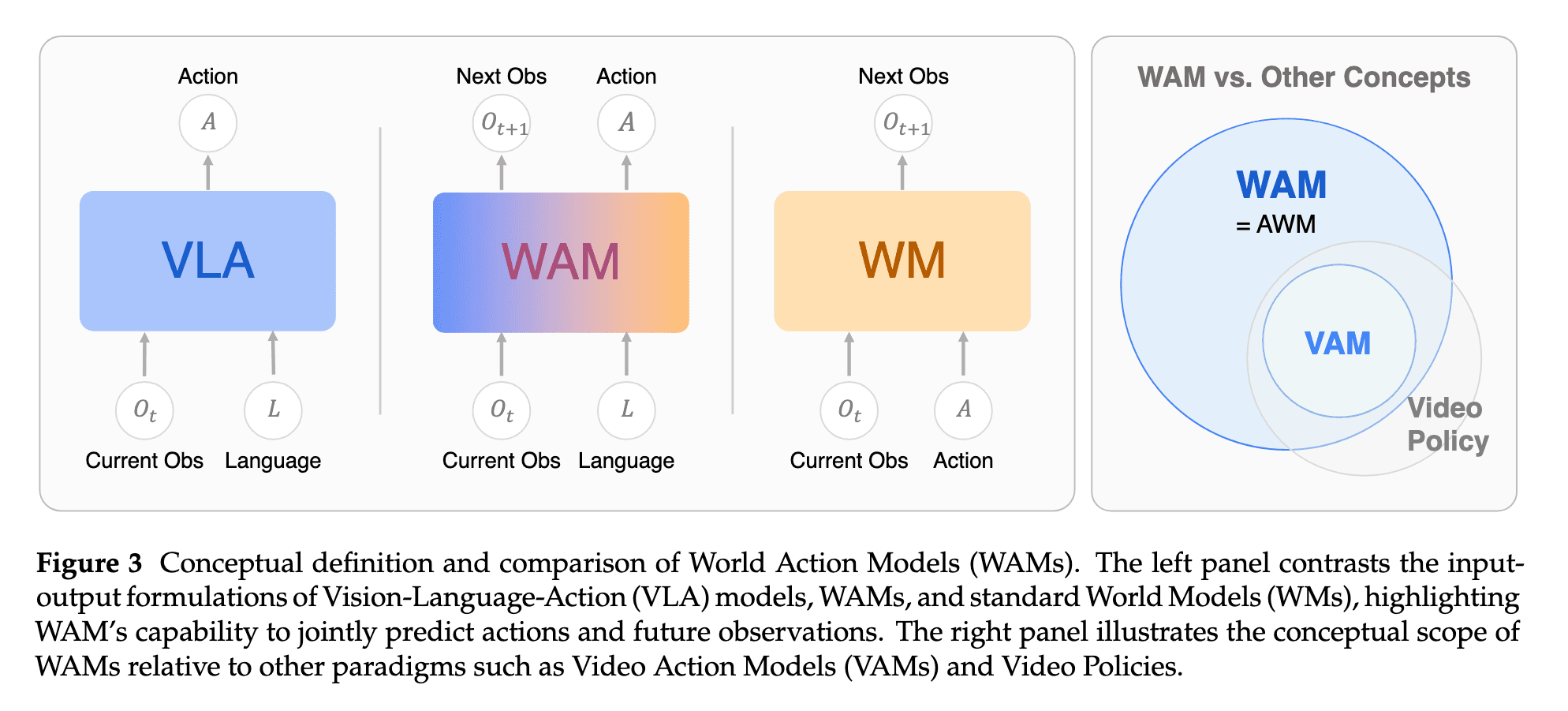

World Models (WM) are defined as predictive transition functions that internalize the causal dynamics of the physical environment (5)

World Action Models (WAMs) are a class of embodied foundation models that unify environmental dynamics modeling (world modeling) with motor control (action generation). (5)

2.2 Disambiguation: WAM vs. Related Concepts
- Video Action Models (VAMs): VAMs often refer to the models that integrate video prediction with action generation, typically aligning action with synthesized visual futures (6)
- Video Policies: Video policies often refer to models defined by their structural heritage—using generative video architectures (e.g., Diffusion Transformers) as a backbone to extract strong spatiotemporal representations (6)
- Action World Models (AWM): Action World Model (AWM) is employed in early literature to describe models that integrate world modeling with action generation (p(o′, a | o, l)) (6)
4 Architecture (13)
We categorize these World Action Models architectures into two primary paradigms based on their structural flow and corresponding training regimes: (13)
(1) Cascaded WAM (13)
employs a sequential pipeline that first predicts the next state (e.g., in pixel, latent, or flow space) and subsequently derives the corresponding action (14)
(2) Joint WAM (14)
unifies predictive state modeling and action generation within a single cohesive model, producing future states and actions simultaneously (14)
5 Training data
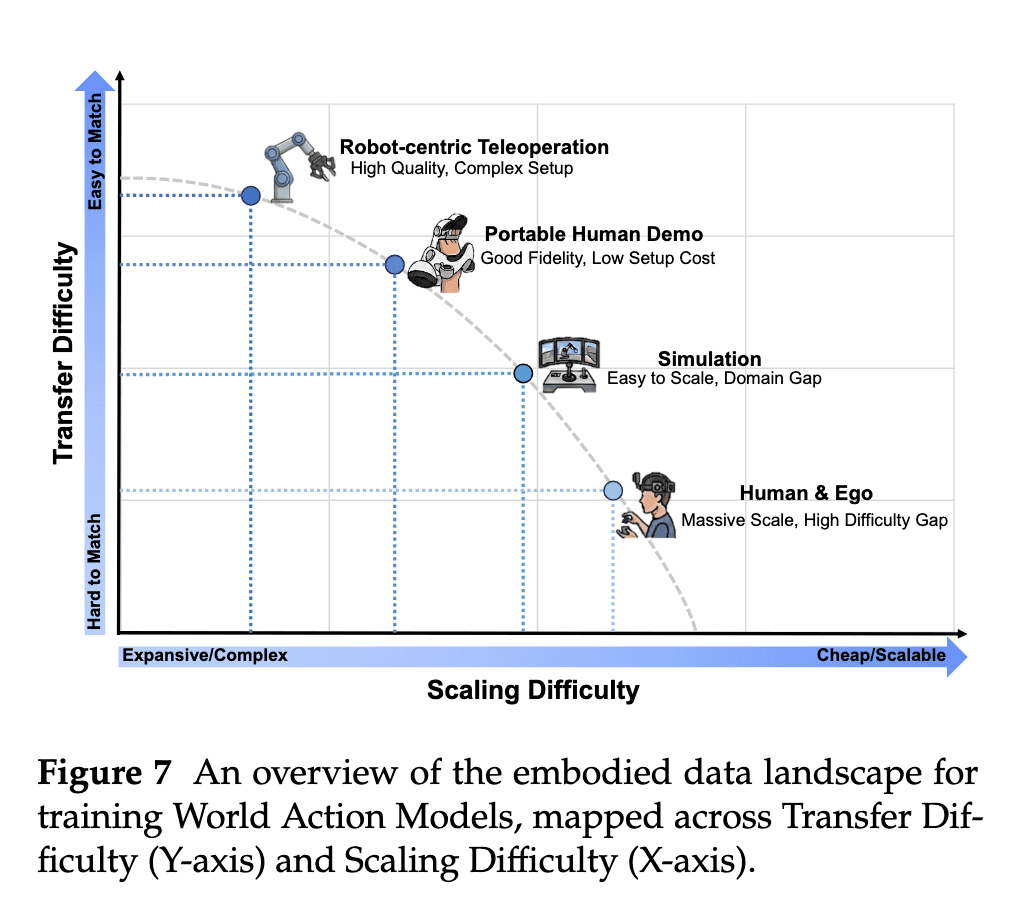
Standard VisionLanguage-Action (VLA) models strictly require paired (ot , at) trajectories, which severely restricts scalability given the high cost and scarcity of teleoperated demonstrations (26)
Teleoperating means human is controlling the robot remotely and the video is captured by the robot / outside.
pure World Models thrive on action-free (ot , ot+1) sequences from internet videos but lack grounding in physical control (26)
unique advantage of WAMs lies in their unified data digestion (26)
high-quality (ot , at , ot+1) triplets to tightly couple their internal representations, while simultaneously possessing the architectural flexibility to ingest massive unpaired data (e.g., action-free videos for visual physics) through joint training strategies (26)
researchers are increasingly leveraging a complementary mixture of these datasets to bridge the gap between precise, low-level robotic control and broad, open-world generalization (27)
5.4 Human and Ego-Centric Data
conventional robot-centric datasets provide precise low-level action execution, they are inherently bottlenecked by the morphological constraints and high collection costs of physical robots (32)
5.4.2 Bridging the Action Gap: Pose Estimation and Proprioceptive Grounding
learning action-conditioned dynamics (st+1 = f (st , at)) strictly requires action inputs (32)
researchers have increasingly treated the human hand as a universal end-effector (32)
these datasets mathematically bridge the gap (32)
5.4.3 Toward Generalist Pretraining Mixtures
7 Open challenges and Opportunities
Data Utilization and Mixture Design.
What is the marginal contribution of each data source as a function of its scale and domain gap? (42)
central challenge in data mixture design lies in disentangling the multiple, potentially overlapping roles that non-robot data plays in grounding. (42)
value of human video through a hierarchy of transferrable knowledge: (42)
(1) low-level physical priors, such as object permanence and gravitational constraints (42)
(2) mid-level causal dynamics, which encode the causal relationship between specific interactions and their physical outcomes (42)
(3) high-level task logic, which encode task-relevant temporal dependencies independent of specific embodiments (42)
more principled information-theoretic perspective on data mixture could allow the field to identify which specific components of world modeling are best learned from internet-scale video versus precision robot demonstrations (42)
8 Conclusions
As generative world modeling and robotics continue to converge, WAM research holds immense promise (44)