- Published on
Understanding Graph Databases: A Comprehensive Tutorial and Survey
- Authors

- Name
- Vishal V
- @VishalVignesh_
Notes
ABSTRACT
prominent graph database systems like Neo4j, Amazon Neptune, and ArangoDB (1)
node and edge creation, attribute assignment, and advanced queries with Cypher (1)
graph visualization techniques using tools such as Plotly and Neo4j Bloom (1)
Louvain method, which support clustering in large networks (1)
I. INTRODUCTION
A. Understanding Graph Theory
1) What are Graphs? Nodes and Edges:
A graph is therefore an ideal way to model networks in various fields. These fields include geosciences, brain studies, transportation networks, etc (1)
2) Types of Graphs: Undirected, Directed, Weighted, Unweighted:
weights can represent distances or time costs (1)
3) Basic Terminology and Notations:
degree of a node, which indicates the number of edges connected to it (2)
Paths represent routes or sequences of edges connecting nodes (2)
adjacency matrix, a square matrix that represents graph connections, simplifies visualization and manipulation (2)
B. Real-World Applications of Graphs
1) Social Networks:
2) Transportation Networks:
Shortest path algorithms like Dijkstra’s and Bellman-Ford are fundamental in reducing travel time and costs across transportation networks (2)
3) Recommender Systems:
4) Biological Networks:
C. Graph Databases
Unlike traditional relational databases that store data in tables, graph databases represent data as nodes (entities) and edges (relationships), making them highly effective for applications where connections between data points are central (2)
1) Differences between Graph Databases and Relational Databases:
Relational databases organize data in tables, enforcing data integrity through primary and foreign keys (2)
RDBMS struggle with queries involving multi-level relationships, as JOIN operations become costly with complex queries (3)
2) Graph Databases: Neo4j:
Neo4j is one of the most widely used graph databases, recognized for its robust property graph model and flexibility in managing and traversing complex relationships (3)
both nodes and edges can have attributes stored as key-value pairs (3)
Neo4j uses the Cypher query language, specifically designed for querying graph structures (3)
ACID (Atomicity, Consistency, Isolation, Durability) transactions (3)
3) Graph Databases: Amazon Neptune:
Amazon Neptune is a managed graph database service by AWS, supporting both RDF and Property Graph models (3)
RDF - Resource Description Framework (everything is a triplet)
Property Graph: Nodes and Edges can have properties / attributes
SPARQL and Gremlin query languages allows users to choose between querying RDF-based semantic data or traditional graph data (3)
v (3)
4) Graph Databases: ArangoDB:
ArangoDB is a unique graph database known for its multi-model capabilities, supporting document, key-value, and graph data models within a single database (3)
uses the Arango Query Language (AQL), which is designed to work across different data models, providing a unified query language that simplifies complex queries involving multiple data types (3)
support both OLTP (Online Transaction Processing) and OLAP (Online Analytical Processing) queries, enabling it to handle both transactional and analytical workloads (3)
useful in use cases like data integration and ETL (Extract, Transform, Load) processes, where data from various sources need to be combined and processed efficiently (3)
Its integration with Kubernetes enhances its adaptability in cloud environments (3)
5) Benefits of Using Graph Databases:
primary benefit is their ability to efficiently model relationships directly in the data structure, which eliminates the need for complex JOIN operations (3)
Graph databases also offer schema flexibility, allowing for dynamic adjustments to data structures without the need for costly schema migrations (3)
II. CREATING AND VISUALIZING BASIC GRAPHS
A. Creating Nodes and Edges
NetworkX: NetworkX is a Python library that simplifies the creation and manipulation of graph structures (4)
Neo4j, nodes and relationships (edges) are created using the Cypher query language (4)
CREATE (a:Person {name: ’Alice’}) (4)
Person (4)
Node Identity
name (4)
Node Property / Attribute
abels Person identify the nodes as representing people (5)
In NetworkX, you can dynamically add or modify both nodes and attributes for every node and edge even if they were not predefined initially like the relationship ”weight” and the node ”Faith” below (5)
In Neo4j, attributes (called properties in Neo4j) are assigned using Cypher when creating nodes and relationships (6)
APOC (6)
Awesome Procedures On Cypher
Neo4j allows data to be exported through the APOC (Awesome Procedures on Cypher) library, which provides extensive functionality for managing data (6)
B. Using Neo4j in Python
C. Case Study: Simple Social Network Graph
III. GRAPH PROPERTIES AND BASIC OPERATIONS
A. Definitions
B. Pathfinding and Shortest Path Algorithms
1) Dijkstra’s Algorithm:
Dijkstra’s algorithm calculates the shortest path from a source node to all other nodes in a graph, with a time complexity of O((m + n) logn) (9)
m is the number of edges (9)
n is the number of nodes (9)
Comparisons with A* have shown that while Dijkstra is generally more resource-intensive for complex environments (9)
2) Implementation in NetworkX:
3) Implementation in Neo4j:
4) Use Cases and Applications:
• Financial Networks: (10)
• Gaming and Simulation (10)
• Robotic Navigation (10)
5) Algorithmic Efficiency Studies
C. Graph Density and Connectivity Analysis
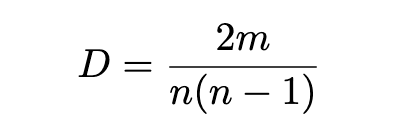
Graph density measures the number of edges in a graph compared to the maximum possible number of edges (10)
1) Connected Components
Connected components represent maximal subgraphs in which any two nodes are connected by paths (10)
3) Connectivity Measures
Connectivity measures quantify a graph’s robustness to disconnections (10)
Key metrics include vertex connectivity (the minimum number of nodes that need removal to disconnect the graph) and edge connectivity (the minimum number of edges that must be removed) (10)
4) Advanced Connectivity Techniques
research explores extended connectivity properties like algebraic connectivity, calculated from the second-smallest eigenvalue of the graph Laplacian matrix (11)
D. Basic Graph Operations for Graph Analysis
IV. MANIPULATING GRAPHS IN NETWORKX AND NEO4J
B. Working with Subgraphs
1) Extracting Subgraphs:
Extracting subgraphs is a common operation in graph analysis, allowing for focused exploration of specific regions or patterns within a large graph (13)
2) Filtering Techniques for Subgraph Extraction
Vertex-based Filtering
filters nodes based on attributes or connectivity (14)
• Edge-based Filtering
filters edges based on weights or relationship types (14)
C. Merging and Comparing Graphs
• Sampling-based Filtering
random node sampling or feature-driven sampling reduce the graph size while preserving important features (14)
3) Advanced Subgraph Analysis Techniques
• Subgraph Matching
FaSTest reduce the sample space by filtering non-matching nodes or edges before analyzing potential subgraph matches, thereby improving efficiency (14)
• Multi-View Filtering
GMADL architecture, analyze subgraphs through multiple criteria or perspectives, enhancing the precision of subgraph extraction (14)
1) Union of Graphs
2) Intersection of Graphs
3) Difference of Graphs
4) Comparing Graph Properties
• Spectral Analysis:
studying the eigenvalues of graph adjacency or Laplacian matrices (15)
• Gromov-Wasserstein Distance
partial GromovWasserstein distance, which maps nodes across partially overlapping graphs (15)
V. ADVANCED GRAPH VISUALIZATIONS
A. Circular Layout
B. Spectral Layout
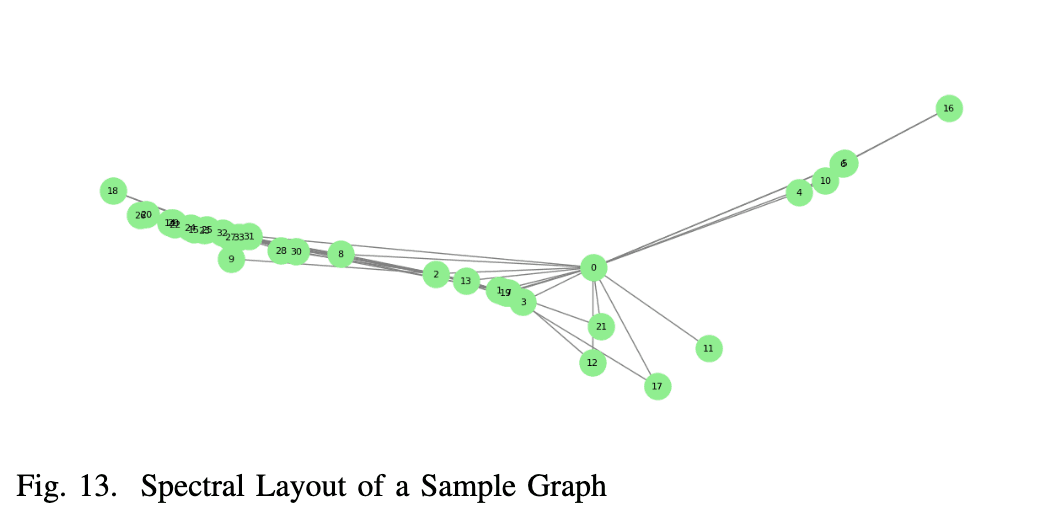
Spectral layouts use eigenvectors of the graph’s Laplacian matrix to place nodes in a way that minimizes certain energy metrics (16)
C. Spring Layout (Force-Directed Layout)
implemented using the Fruchterman-Reingold algorithm, models the graph as a physical system where nodes repel each other while edges act like springs, pulling connected nodes together. (16)
VI. ADVANCED GRAPH ALGORITHMS
A. Community Detection and Clustering
1) Louvain Algorithm
Louvain algorithm is a popular method for community detection in large networks (19)